
Clark County Civil Docket Searches
A Clark County civil docket search goes fastest with the exact case number. Superior Court numbers follow a pattern. The pattern uses the year, the case type, a sequence, and a county code. A civil filing might read 23-2-01234-06. Here the 2 marks a civil case and the 06 marks Clark County. Domestic matters use segment 3. Probate and guardianship use 4. Other Superior case families carry their own segments.
For Clark County Superior case information that is available online, use Odyssey Portal. The Washington Courts Case Search can find an index entry across court levels. It will not hand you filed pleadings or a certified record. District Court or municipal matter? Go to the court that actually holds the lower-court file.
- Identify Superior, District, or the named municipal court.
- Search the exact number, or narrow a party or business name by court.
- Confirm Clark County, case type, filing date, and assigned department.
- Cross-check a hearing on the daily schedule, Where's My Case, or civil calendar.
- Use the correct clerk's copy process for pleadings, orders, judgments, or certification.
Clark County Civil Odyssey Search
Smart Search is the public's main way into Clark County Superior civil files on Odyssey. The landing page offers more than Smart Search. Search Hearings sits there. So do Party Name Search information, Judgment Search, clerk contacts, help, and a user guide. The portal needs JavaScript and cookies to run. Anonymous visitors may see case information. Documents can require a registered role or Clerk authorization. The official Clark County Odyssey access page shows exactly where that search boundary sits.
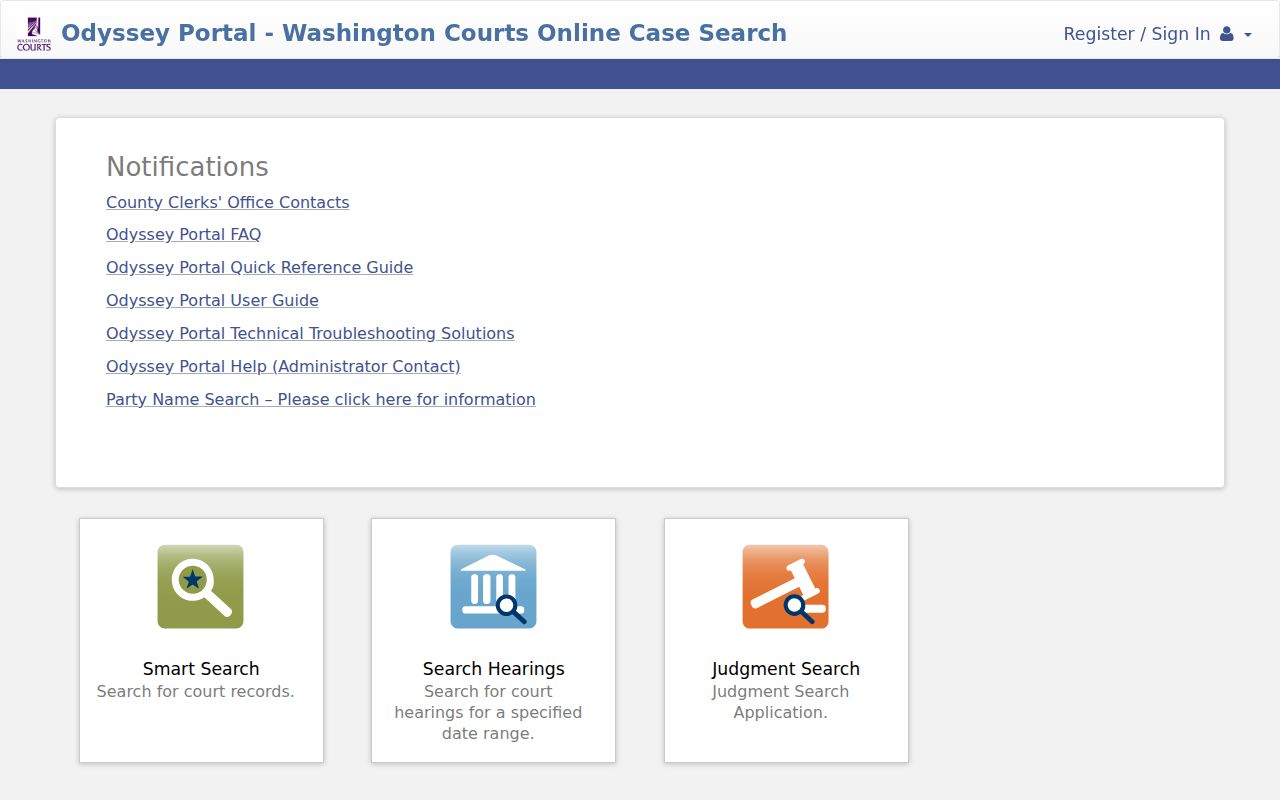
A blank result can mean many things. The name may be misspelled, the court may be wrong, the filing may be recent, the matter may be restricted, or the record may simply be a legacy one. And when a document title shows up with no open link, it can still be part of the Clerk's official file.
Civil Dockets: What They Show
A Clark County civil court docket is a register of events. It is not the whole evidence file. It names the caption and the parties' roles. It also lists the filing date, the cause or case type, and the assigned department. It tracks service, motions, settings, orders, judgment, costs, appeal, and restricted flags. Read entries in order. When the legal result matters, open the operative order itself.
| Case number | Identifies court, year, case family, sequence, and Clark County code in the Superior format. |
|---|---|
| Caption and roles | Names parties as plaintiff, defendant, petitioner, or respondent. |
| Filings | May list a complaint, petition, answer, notice, motion, or proof of service. |
| Setting | Shows a planned hearing, trial, presentation, or motion date that can change. |
| Order or judgment | Points to the court's ruling; the docket summary may not contain the full terms. |
| Access flag | Signals redaction, sealing, or other limits without disclosing protected content. |
Dates can fool you here. A filed date is not a hearing date, and a motion entry is not a ruling. Any settlement note, continuance, dismissal, decree, or judgment still has to be checked against the signed record.
Clark County Civil Motion Calendars
The Clerk posts commissioner, civil-motion, and family-law calendars for anyone tracking a hearing date. A separate domestic-relations page holds the family calendar material. These calendars tell you when and where a matter is set, and nothing more. An entry is not the motion itself. Nor is it the response, exhibit, minute entry, or signed order. The county's own page appears next. It routes visitors to the commissioner and motion calendars.
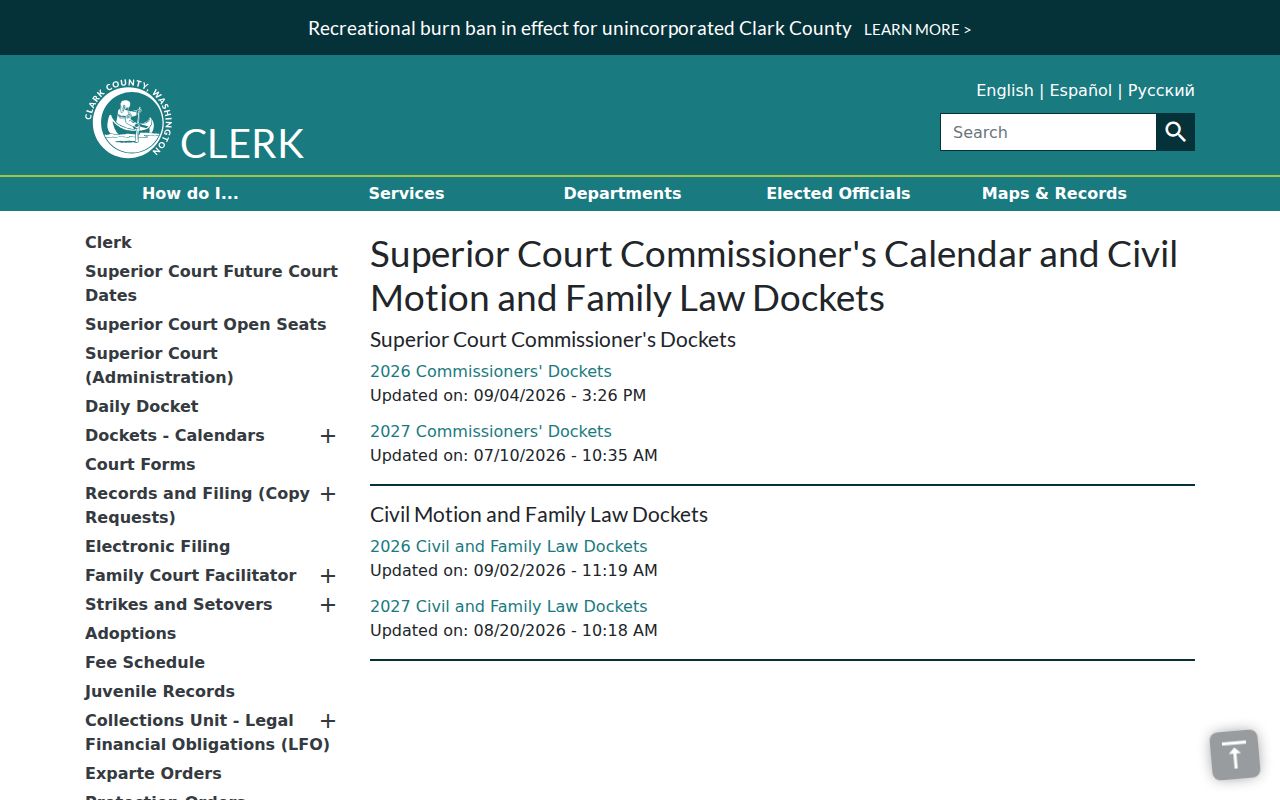
Dates move, so confirm the current setting through the daily schedule or the court. Local rules control notice, assignment, bench copies, remote appearances, and continuances. Calendar text is not a permanent remote-hearing credential.
What Cases Fill the Civil Docket
Clark County Superior Court takes the broad civil claims and general-jurisdiction matters. Its civil side also holds domestic relations. Probate and guardianship sit there too. So do adoption and parentage, protection orders, and other categories. Access is not the same across those labels. District Court hears civil claims within its statutory authority and runs the small-claims track.
- Contract, tort, property, and other general civil claims
- Divorce and other domestic-relations matters
- Probate and guardianship proceedings
- Adoption, parentage, and protection-order matters
- District Court civil claims and small claims
Washington's District Court statute now reaches civil claims up to a statutory cap, and that figure does not line up neatly with an older Clark County summary of Superior jurisdiction. Do not squeeze the two numbers into one boundary. For the current rule, check RCW 3.66, the court rules, and the specific cause of action.
Clark County Small Claims Track
Small claims are District Court matters, not small Superior Court cases. Under RCW 12.40, the common ceiling is $10,000 for a natural person. It is $5,000 for other claimants. The limits stay subject to current law and the claim's facts. That track has its own service, hearing, judgment, and appeal steps.
A Washington state index can help you locate the case. The District Court still holds the pleadings, the judgment, and any recording. Visit the counter or call 564-397-2424. You can also follow the official records-request path. Attorney, agency, business, and government e-filing uses the county Serv-U process when eligible. Self-represented filers use paper. Filing access and public record viewing are two separate functions.
Routing point: Read the court name on the claim or hearing notice. An Odyssey search aimed at Superior Court will not replace a District Court file search.
Hearings on the Civil Docket
Clark County civil hearing tools cover a wide range. They include the Superior daily schedule, Where's My Case, civil-motion calendars, family-law dockets, and domestic-relations dockets. The daily schedule can give the date, time, courtroom, docket type, judicial officer, and location. Where's My Case adds court, title or name, time, and location controls. Both are scheduling tools rather than records of results. The county's domestic-relations docket page is one of these specialized calendar sources.
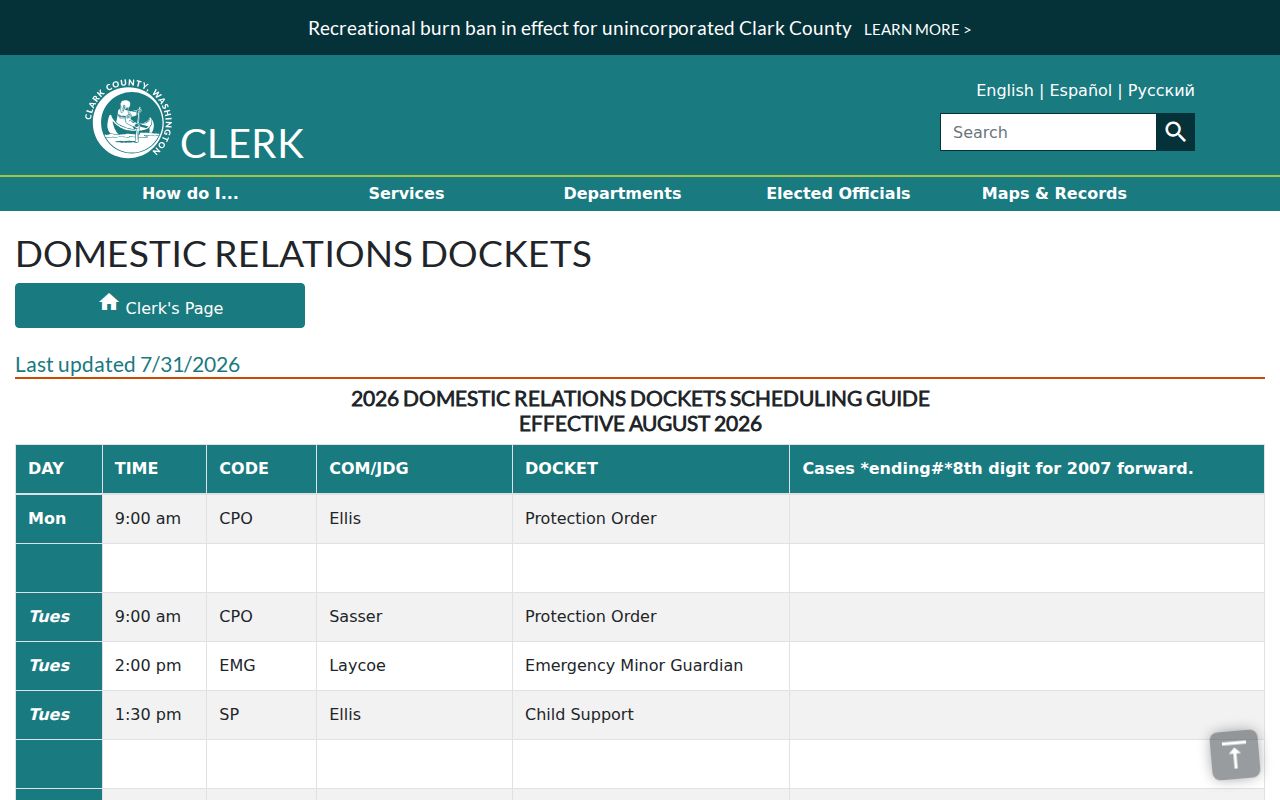
A scheduling order drives many civil dates. Continuances or amended notices can shift them later. For a hearing that is close at hand, confirm with the court, and after the setting use the register or minute entry to learn what took place. The Clark County Court Schedule lays out the fuller date workflow.
Clark County Civil Copy Requests
Start with the Clark County Clerk's copy form. It wants your contact details, the case number or party names, a sub-number if you have one, and the precise document you need. Pick a copy type and choose delivery or pickup. You can ask for a whole file instead of a single item. Send the form by whatever route the Clerk currently publishes: counter, mail, fax, or email. Bigger orders may need a quote and prepayment first.
Check the current Clerk fee schedule before you order. Certified copies run $5 for page one and $1 for each page after that. Noncertified or electronic pages cost $0.50. An archived or pre-1996 microfilm search is $30, and special research is $30 per hour. Confirm the schedule in effect when you place the request.
| Need | Best product | Custodian |
|---|---|---|
| Track events | Docket or case summary | Portal and court |
| Read a filing | Plain document copy | Clerk holding the file |
| Prove an official record | Certified copy | Clark County Clerk or District Court |
OnBase imaging holds public Superior Court files from about 1985 forward. Anything older may live on microfilm. So an index entry without an online image usually calls for staff research, not another portal query.
Clark County Civil Court Lines
Which court holds your Clark County civil docket? Superior Court carries broad original jurisdiction under RCW 2.08.010. District Court takes limited civil and small-claims matters. Municipal courts mostly handle city-code issues. A city-issued civil infraction, though, can stay with that municipal or contracted court. Federal civil cases belong to the Western District of Washington and PACER. They are not in Odyssey or the Clark County Clerk.
An appeal adds a file; it never erases the trial docket. A District case can move up to Superior Court through the applicable appeal process. A Superior appeal goes to the Washington State Court of Appeals, Division II. Sometimes it moves on to the state Supreme Court. Track both the trial and appellate numbers so filings never get mixed.
Note: Court level turns on the claim, the relief requested, the statute, and current jurisdiction rules. It is not just the dollar amount typed into a complaint.
Who Can See Civil Dockets
Washington sets its court-record access rules at the state level. General Rule 31 builds the framework for public access to court dockets. General Rule 22 shields identifiers and sensitive material in family, protection, and guardianship records. Adoption, juvenile, mental-health, and sealed files face still more limits. A public docket can note that an event or sealed filing exists. It still keeps the contents hidden.
General Rule 15 controls sealing and redaction, which require a court process and written findings. After protected data come out, the document itself may stay public. Never read a child's details, an address, account data, or hidden allegations into an access flag. Administrative court records fall under GR 31.1, while case copies go through the clerk route.
Clark County access chain: Use the public calendar, state index, Odyssey summary, Clerk terminal or OnBase, and then a plain or certified copy. Each level offers different detail and authority.
Plenty of other channels exist for a Clark County docket search. Try Superior civil, probate, or family phone help, District Court's counter and records process, copy requests by mail, fax, or email, JIS-Link subscription access, or the right municipal clerk. And remember: a gap online never proves a file is missing.